Beyond Visual Redesign: Rebuilding Hubway Stone Around a New Business Model

A website redesign is often associated with updated visuals, improved typography, new photography, and cleaner navigation. But what happens when the company’s business model has changed, and the existing website no longer explains how the business actually operates?
That was the challenge behind the redesign of Hubway Stone, an international natural stone sourcing and supply company working with selected producers in Turkey and additional sourcing partners in Brazil and Greece.
The project started with a fundamental question: Does the existing website accurately represent the company’s current business model and the way its customers purchase natural stone?
Answering that question led us beyond visual improvements. The redesign became a broader restructuring of the website’s architecture, product presentation, navigation, and content.
01. The Starting Point: A Website Built for an Earlier Business Model
The previous Hubway Stone website focused primarily on supplying natural stone materials for projects in the United States.
Its homepage introduced project-based stone supply from Turkey, followed by material collections, finished products, supply coordination, and information about long-term partnerships.
This structure reflected an earlier stage of the business. It gave visitors a general understanding of the materials available and the company’s role in project-based supply.
However, Hubway Stone’s operating model was evolving.
Rather than presenting itself primarily through a catalog and container-based supply programs, the company was developing a broader sourcing approach built around direct producer relationships, material selection, custom production coordination, and international supply.
The existing website contained much of this information, but its structure did not communicate the new model clearly enough.
Simply replacing photographs or rewriting individual sections would not solve that problem.
02. Rethinking the Homepage
The homepage was the first area we reconsidered.
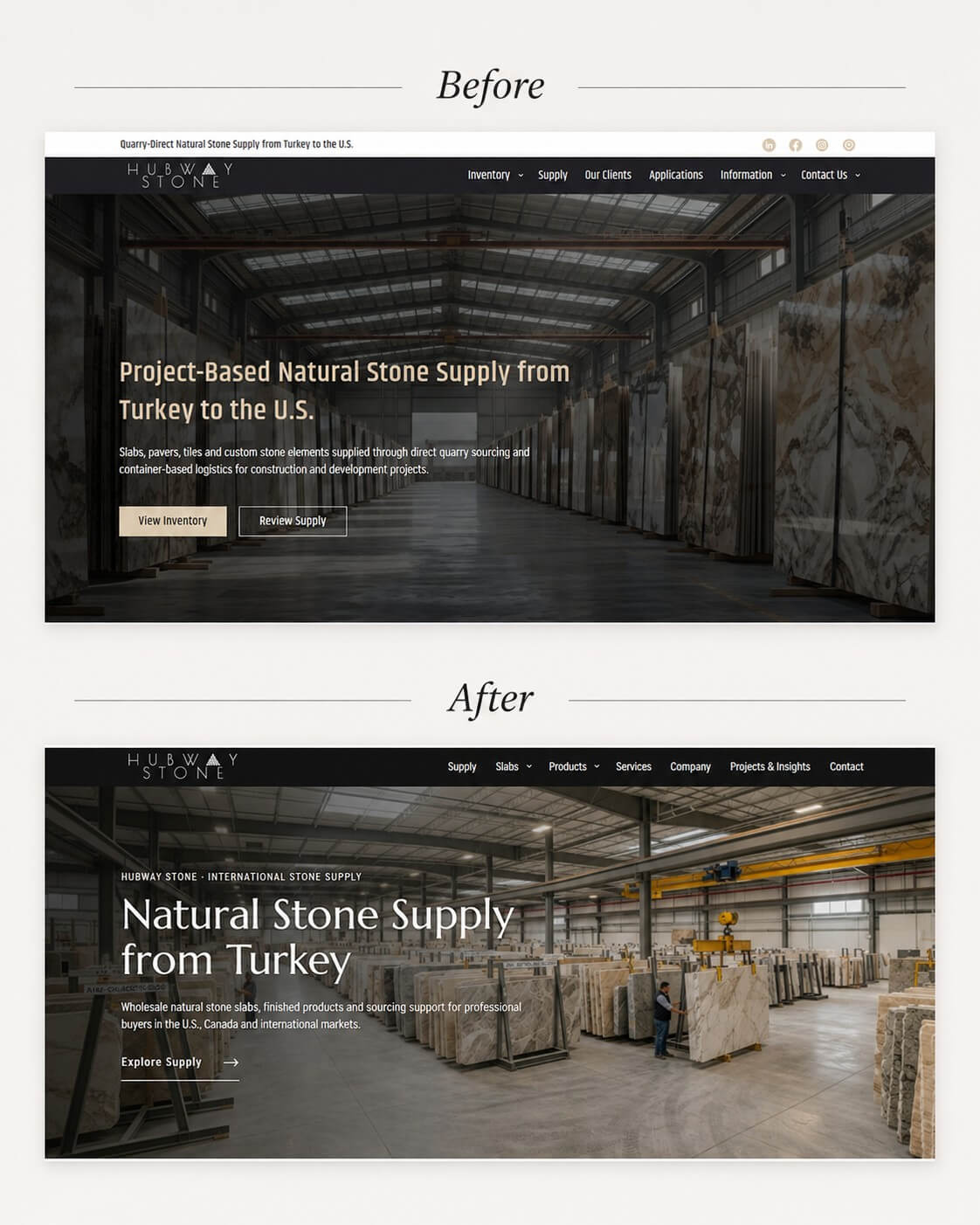
Previously, the hero introduced Hubway Stone with the message:
“Project-Based Natural Stone Supply from Turkey to the U.S.”
The positioning was specific, but it also placed considerable emphasis on one destination market and a project-based supply arrangement.
The revised business model required a broader introduction.
The redesigned homepage now opens with:
“Natural Stone Supply from Turkey”
The supporting content explains that Hubway Stone supplies natural stone slabs and finished products while providing sourcing support for professional buyers in the United States, Canada, and international markets.
Turkey remains central to the company’s sourcing network, but the website no longer defines the business primarily by one export destination.
The primary action also changed. Instead of directing visitors toward inventory or a general supply overview through competing buttons, the hero now introduces a clearer path to the Supply section.
Organizing the Homepage Around Buyer Needs
The changes continued below the hero.
The previous homepage presented stone materials, finished products, supply workflows, and partnership advantages across several independent sections.
Although this content was relevant, the relationship between products and sourcing services was not immediately clear.
We replaced that presentation with three primary entry points:
- Natural Stone Slabs: For buyers sourcing marble, travertine, limestone, quartzite, and other slab materials.
- Finished Stone Products: For buyers requiring tiles, pavers, mosaics, pool coping, and architectural stone components.
- Sourcing & Local Support: For companies needing producer selection, material sourcing, production coordination, and assistance through the supplier network.
This distinction reflects an important characteristic of B2B stone purchasing: different buyers approach suppliers with different requirements.
A fabricator looking for slabs may follow a different purchasing process from a contractor ordering manufactured stone components to project specifications.
The homepage now introduces both paths without forcing visitors through a single product catalog.
The remaining sections were also simplified. Material categories became easier to explore, while the company’s operational advantages were consolidated into a shorter explanation of its sourcing approach.
The goal was not to add more content, but to give existing information a clearer hierarchy.
03. From Inventory to a More Focused Slab Catalog
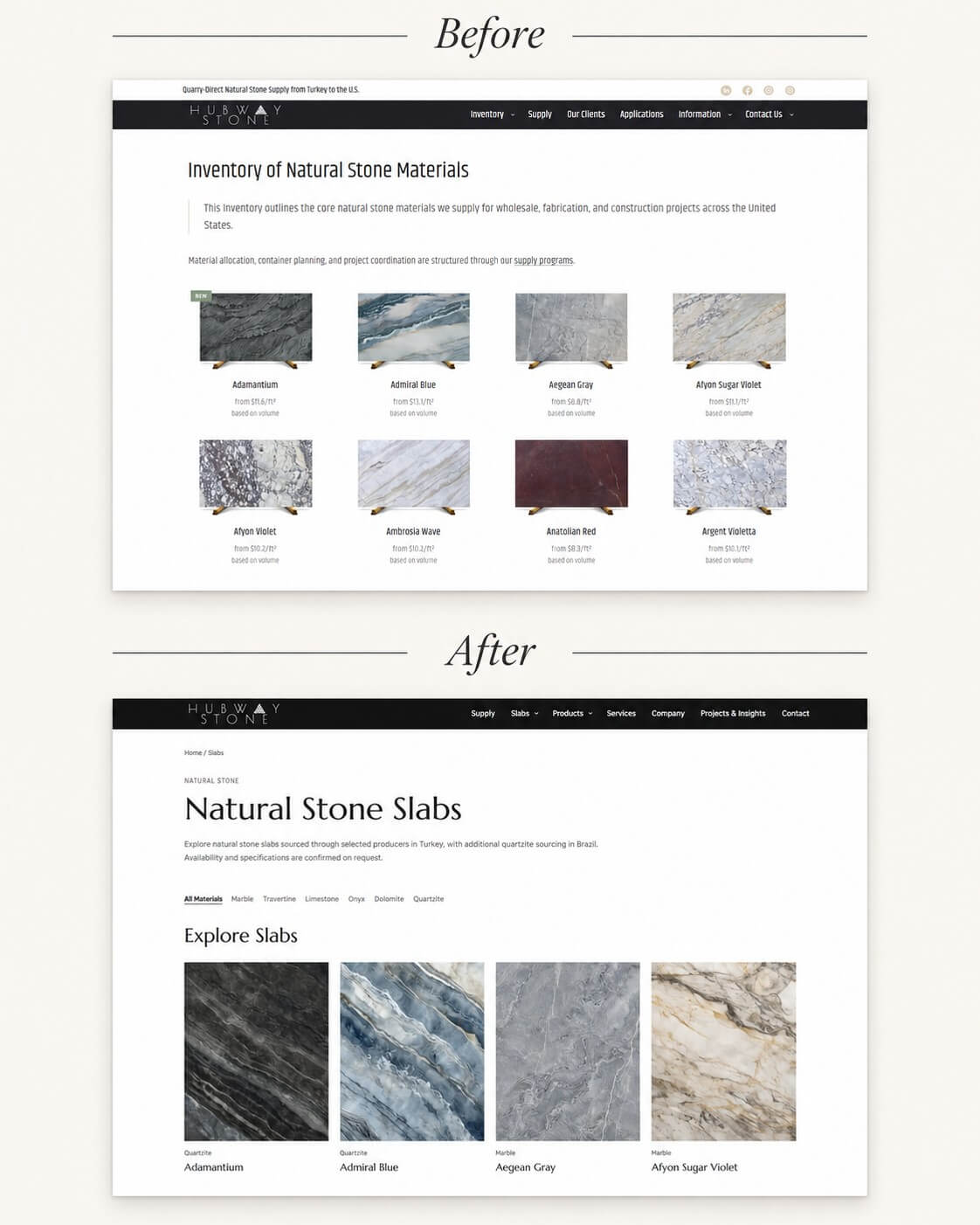
The previous material catalog was presented as an inventory of natural stone available for wholesale and construction projects.
Individual materials appeared in a product grid with photographs, names, and indicative prices per square foot.
That approach had limitations for the new sourcing model.
Hubway Stone does not operate solely as a warehouse selling a fixed selection of materials at predetermined prices. Availability, specifications, production options, and pricing can depend on the producer, material selection, order volume, and project requirements.
Presenting indicative prices alongside inventory-style product cards could create expectations that did not fully reflect the actual purchasing process.
We therefore reconsidered both the structure and presentation of the catalog.
The redesigned section, Natural Stone Slabs, focuses on material exploration rather than suggesting a conventional online inventory.
Visitors can browse by stone type, including marble, travertine, limestone, onyx, dolomite, and quartzite.
The new cards use larger material imagery, simpler typography, and fewer competing elements.
Indicative prices were removed from the listing, while availability and specifications are presented as details to be confirmed through an inquiry.
This was more than a visual adjustment.
It helped align the catalog with the company’s actual sourcing process and made the distinction between browsing materials and confirming supply conditions more explicit.
04. Rebuilding the Supply Page Around the Sourcing Process
The Supply section required a more substantial change.
Previously, the page focused on natural stone supply for U.S. projects, with references to container shipments, material availability, quality control, and delivery coordination.
These capabilities remained relevant, but the presentation was primarily built around a predefined supply arrangement.
The new business model needed to explain something different: how Hubway Stone helps buyers source materials through a network of selected producers.
The redesigned Supply page now introduces the company’s role in material sourcing and custom production coordination.
It also explains the geographic scope more accurately, with Turkey as the primary sourcing market and additional options in Brazil and Greece.
Rather than presenting supply as a single predefined process, the new page introduces two ways a sourcing inquiry may begin.
Current Availability
Buyers can explore materials available through selected producers. Hubway Stone can review current slabs, verify specifications, coordinate photographs or samples, and confirm availability before an order proceeds.
Sourcing by Reference
Buyers can provide a material name, photograph, physical sample, or technical specification. The company can then identify comparable options and coordinate material selection through its producer network.
This distinction is important because professional buyers do not always begin with an existing supplier catalog.
Architects, fabricators, and contractors may already have a particular material in mind and need help locating an appropriate source.
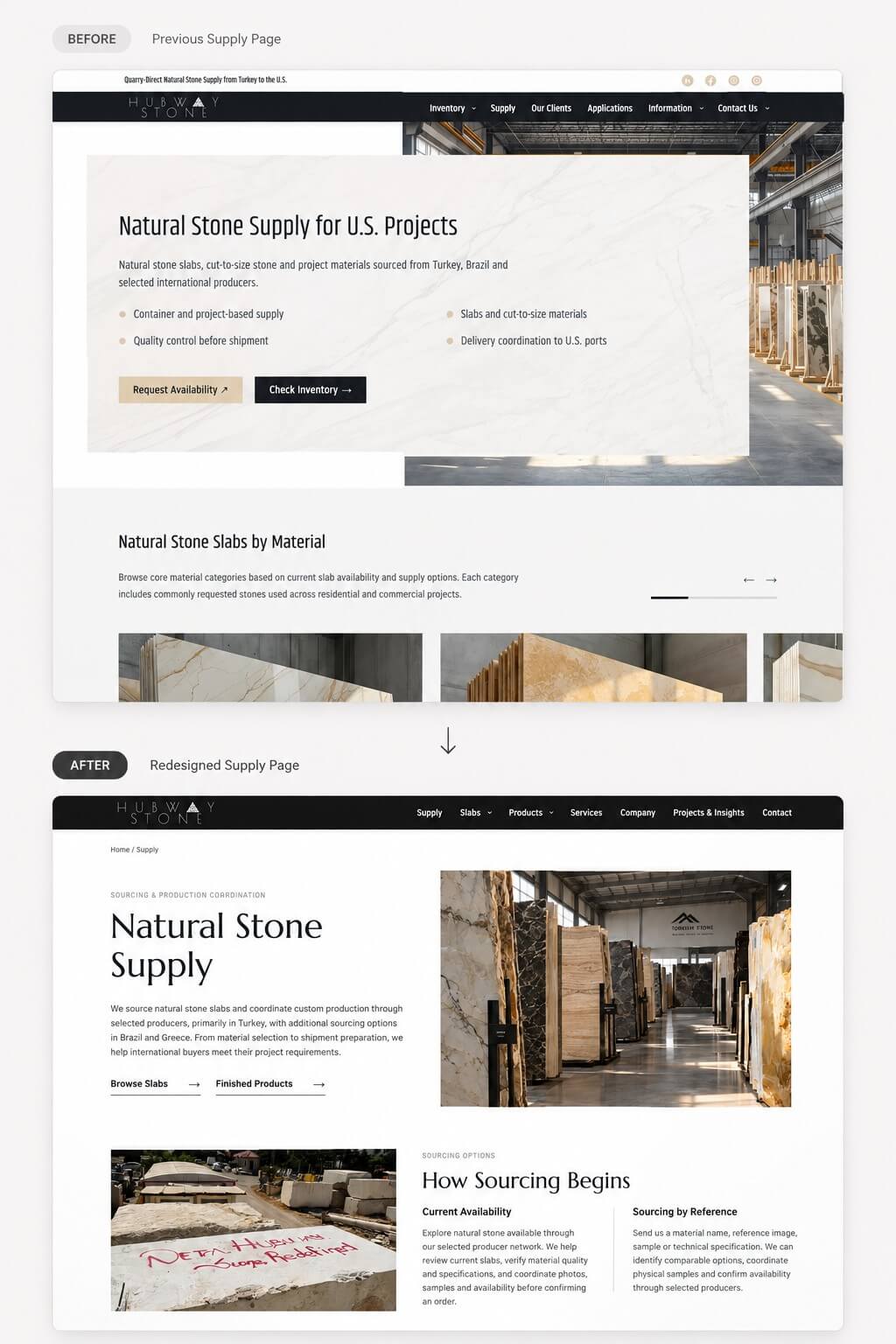
The revised page also provides clearer links to Slabs and Finished Products.
These links connect the sourcing process to the relevant material and product categories without duplicating the entire catalog inside the Supply section.
05. Simplifying the Website Architecture
The redesign also required decisions about what the website no longer needed.
The previous navigation included sections such as Our Clients and Applications, along with Inventory, Supply, and Information.
Not every existing section deserved to remain a separate destination.
Some pages contained useful information but served overlapping purposes. Others no longer contributed meaningfully to the company’s revised positioning.
Instead of retaining every page and adding more sections around them, we reconsidered the navigation from the perspective of a professional buyer.
The new primary structure gives clearer roles to Supply, Slabs, Products, Services, Company, and Projects & Insights.
This involved removing or consolidating weaker pages, reorganizing existing content, and establishing more meaningful relationships between sections.
The objective was not to reduce page count for its own sake.
It was to eliminate unnecessary complexity and make important information easier to find.
The same principle informed the SEO restructuring. Content was reviewed to reduce overlap, clarify page purposes, and support a more coherent internal linking structure.
For a specialized B2B website, a focused architecture can be more useful than a large collection of pages with limited differentiation.
06. Introducing a Dedicated Products Section
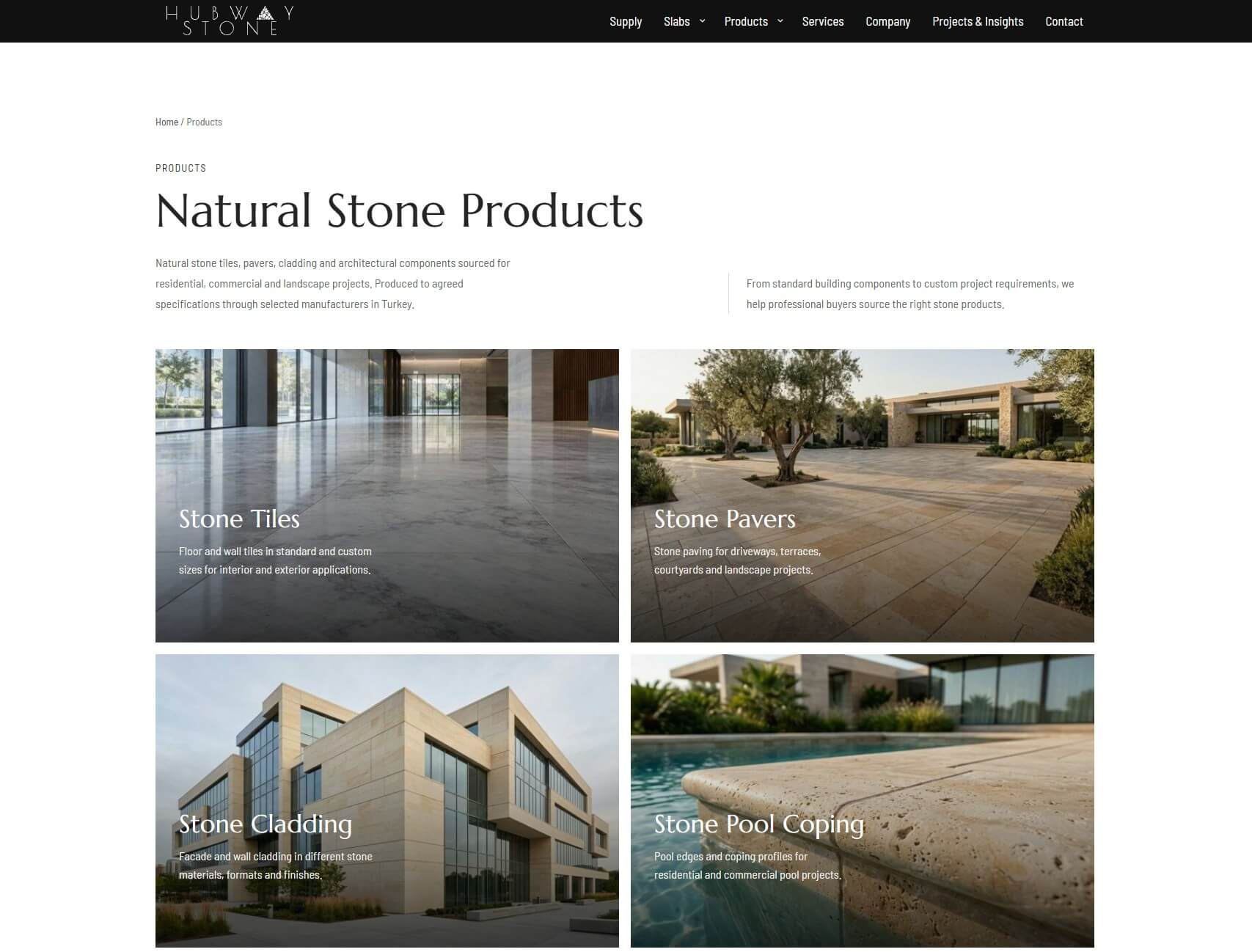
One of the most important additions was a dedicated Products section.
Previously, the website presented slabs and finished stone materials within a broader supply-oriented structure.
However, these categories represent different purchasing requirements.
Natural stone slabs are typically evaluated by material type, color, dimensions, thickness, and selection availability.
Finished and cut-to-size products require additional information about manufacturing possibilities, dimensions, finishes, tolerances, and project specifications.
The redesigned website separates these paths.
The new Products section introduces categories including stone tiles, pavers, cladding, pool coping, and architectural stone components.
Each category has a defined place within the website, allowing buyers to explore the relevant products without navigating through unrelated slab listings.
This structural distinction also creates opportunities for more focused product information and internal linking.
Instead of treating all natural stone offerings as one broad catalog, the website can explain the specifications and sourcing considerations relevant to each product category.
07. Building Trust Through Real Projects
Another significant addition was Projects & Insights, including a dedicated area for documenting real sourcing and supply projects.
Trust is particularly important in international natural stone supply.
Professional buyers may need to evaluate materials, production capabilities, and supplier reliability without visiting the quarry or factory themselves.
General marketing statements have limited value when buyers are making decisions involving significant material quantities, production schedules, and international logistics.
We therefore introduced a structure for documenting actual projects.
Project pages can explain the materials involved, customer requirements, sourcing decisions, production coordination, quality checks, and shipment preparation.
Where available, they can also include photographs from different stages of the process.
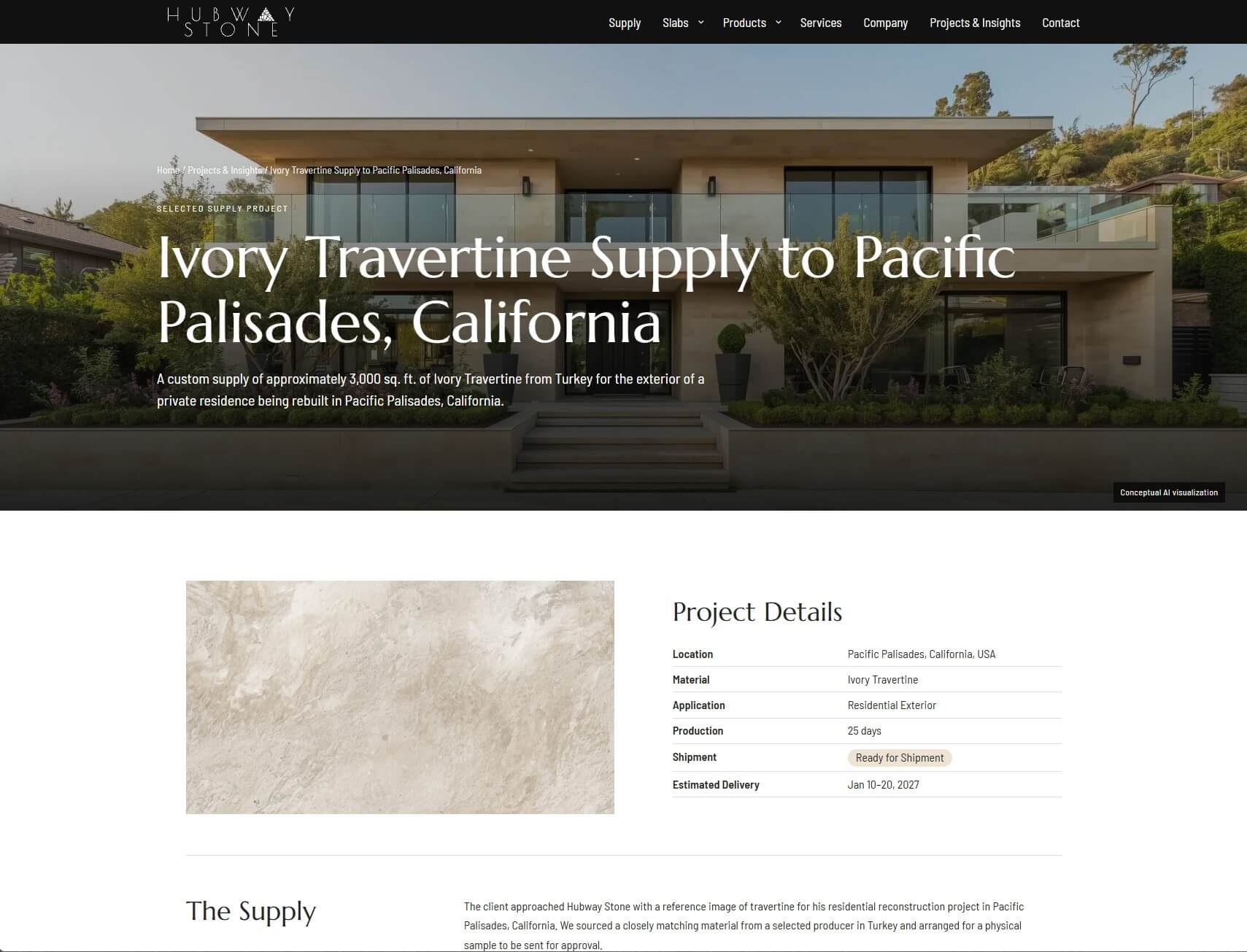
The purpose is not simply to create another portfolio gallery.
It is to provide evidence of how the company works and to make aspects of its sourcing process more transparent.
As additional projects are completed and documented, this section can become a valuable source of practical information for prospective buyers.
08. Visual Design Followed the Structural Decisions
Although the website’s appearance changed considerably, the visual redesign was not the starting point.
Once the new architecture had been established, the design system was developed to support it.
The revised website uses a more restrained editorial style, larger typography, consistent image proportions, clearer section spacing, and simpler navigation.
Product imagery remains central to the presentation, but photographs no longer need to explain the entire business on their own.
Headlines, supporting content, and links now work together to establish a clearer hierarchy.
We also reduced reliance on large content carousels where more direct navigation could serve visitors better.
These decisions were intended to improve clarity and make the website easier to scan, particularly for professional buyers looking for specific materials or supply capabilities.
The result is a visual system built around the information architecture rather than an attractive layout imposed on the previous structure.
09. The Outcome: A Website That Better Represents the Business
The Hubway Stone project demonstrates why some redesigns require much more than visual modernization.
The company’s evolving sourcing model prompted a broader reconsideration of how its website should work.
The homepage was reorganized around the business offering. The slab catalog was repositioned from inventory-style browsing toward material exploration. The Supply page was rebuilt to explain sourcing flexibility and producer coordination.
A dedicated Products section created clearer paths for buyers of finished stone materials, while Projects & Insights introduced a framework for documenting actual supply activities.
At the same time, unnecessary pages were removed or consolidated, and the navigation became more focused.
These changes established a website structure that more accurately reflects how Hubway Stone operates and how its professional customers approach sourcing decisions.
The long-term effects on organic visibility, buyer engagement, and inquiry generation will require ongoing measurement.
For now, the most significant result is the alignment between the company’s business model and its digital presentation.
A meaningful website redesign is not always about making an existing website look better. Sometimes it requires reconsidering what the website needs to communicate, how its information should be organized, and what its customers actually need to accomplish.


